
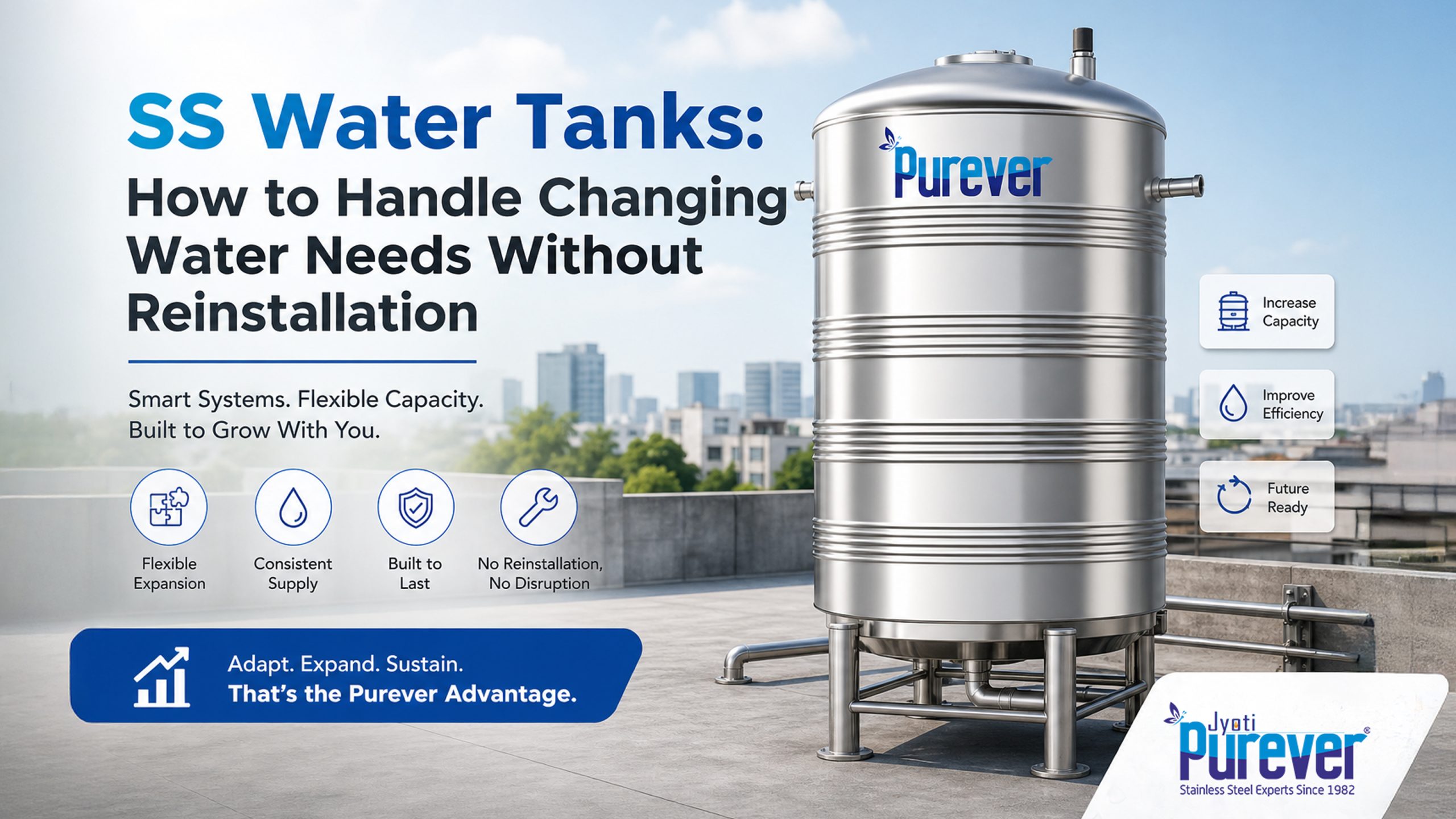
There’s a phase most homes and buildings go through. Everything was planned right at the start – capacity, usage, storage. The stainless steel water tank installed back then did its job perfectly.
Then life changed a little. Maybe an extra floor was added. Maybe more people moved in. Maybe usage simply increased without anyone noticing.
And suddenly, the tank feels… just enough. Not failing, but not comfortable either.
That’s where the question comes in, do you need to remove and reinstall everything?
Most of the time, you don’t.
The Mistake: Treating Capacity as Fixed
When people install ss water tanks, they usually think of capacity as a fixed number. This tank holds X litres, so that’s what you’ll always have.
But real usage isn’t fixed. It shifts over time.
Morning routines get busier. Appliances increase demand. Commercial spaces expand. The original calculation slowly becomes outdated.
The problem isn’t that stainless steel water tanks can’t handle change, it’s that they’re often installed without flexibility in mind.
Think in Systems, Not Single Tanks
One of the easiest ways to handle changing demand is to stop thinking of the tank as a single unit.
Instead of replacing your existing stainless steel water tank, you can build around it.
Adding another unit, connected properly, can:
Increase total capacity
Reduce pressure on the original tank
Create a buffer during peak hours
This approach is far more practical than removing a perfectly functional system.
Modern setups with ss water tanks often follow this layered design.
Space Isn’t Always a Limitation
A common concern is, “Where will another tank even go?”
But most spaces have more flexibility than they appear to. The key is how the tank is designed.
Well-planned stainless steel water tanks can be:
Taller instead of wider
Placed along edges instead of central areas
Divided into smaller interconnected units
This flexibility allows expansion without disturbing the existing layout.
And since stainless steel supports precise fabrication, adapting a stainless steel water tank setup becomes much easier.
Flow Matters as Much as Storage
Here’s something people realise a bit late, you can increase capacity and still face issues.
If flow isn’t balanced, additional storage won’t solve the problem.
When expanding ss water tanks, it’s important to ensure:
Proper inlet and outlet positioning
Balanced distribution across pipelines
Efficient refill cycles
This is what turns added capacity into usable supply.
The Advantage of Not Starting Over
Reinstallation sounds simple on paper. In reality, it’s disruptive.
Pipes need adjustment. Space needs reworking. Daily routines get affected.
That’s why working with your existing stainless steel water tank setup—rather than replacing it, makes more sense.
With thoughtful planning, stainless steel water tanks can evolve with your needs instead of being replaced every few years.
Where Purever Fits In
Purever focuses on building systems that adapt over time. Their stainless steel water tanks are often designed to allow expansion, whether through modular additions or flexible layouts.
Instead of treating a stainless steel water tank as a fixed solution, Purever’s approach to ss water tanks supports long-term usability, helping homes and buildings grow without constant reinstallation.
When Growth Doesn’t Mean Starting Over
Water needs will change. That’s inevitable.
But your system doesn’t have to restart every time they do.
With the right approach to stainless steel water tanks, supported by flexible ss water tanks setups, you can expand, adjust, and adapt – without tearing everything down.
And honestly, that’s the smarter way to build anything meant to last.