
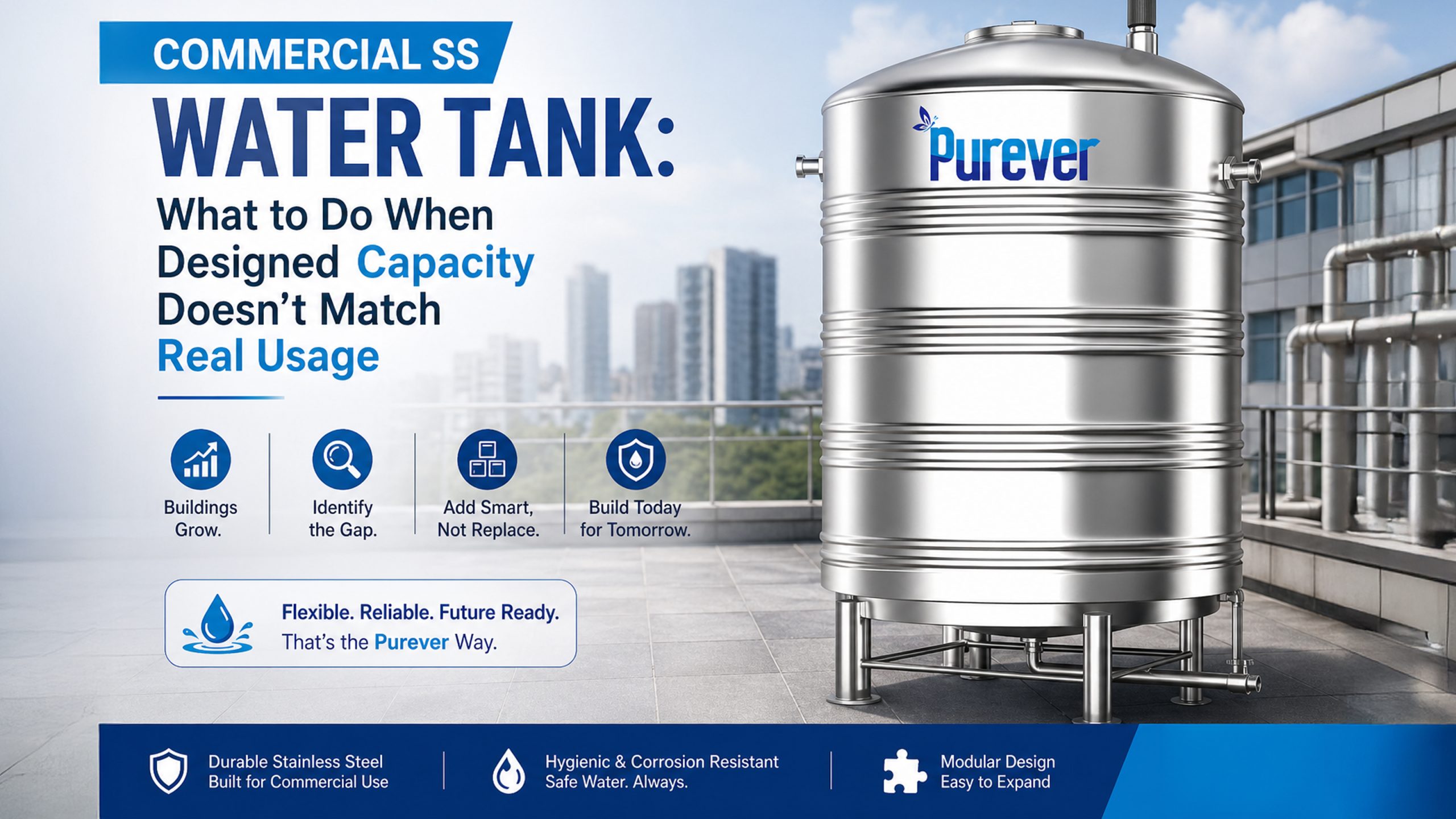
There’s a very specific kind of problem that shows up in commercial buildings, not immediately, but a year or two after everything is “complete.”
On paper, the numbers were right.
Capacity matched occupancy.
The system was approved, installed, and signed off.
And yet…
Peak hours feel tight,
Pressure drops,
And someone inevitably says, “This wasn’t supposed to happen.”
That’s the moment you realise the Commercial SS Water Tank was designed for the building you planned, not the building you actually ended up running.
Step One: Don’t Panic, This Happens More Than You Think
Buildings evolve faster than infrastructure.
A hotel adds more rooms.
A hospital increases capacity.
An office grows beyond initial projections.
Suddenly, the original Commercial stainless steel Water Tanks setup starts operating at its limit.
It’s not failing, it’s just stretched.
And that distinction matters, because it means the system can often be improved without starting from scratch.
Step Two: Identify the Real Gap
Before changing anything, it’s worth asking a simple question:
Is the issue storage… or flow?
Sometimes the Commercial SS Water Tank capacity is actually enough, but:
Refill cycles are too slow
Distribution is uneven
Peak demand isn’t balanced
Other times, the building has simply outgrown its storage.
Understanding this difference helps avoid unnecessary changes.
Step Three: Think Addition, Not Replacement
A common mistake is assuming the entire tank needs to be replaced.
In many cases, a smarter solution is expansion.
Adding another unit to existing Commercial stainless steel Water Tanks setups can:
Increase capacity
Reduce pressure on the main tank
Create a buffer during peak hours
This layered approach is far more practical than removing a working system.
That’s why modular setups are becoming common in Commercial SS Water Tank planning.
Step Four: Fix the System, Not Just the Tank
Even when capacity is increased, ignoring system design leads to the same problem repeating.
A well-balanced setup ensures:
Multiple outlet points
Proper flow distribution
Efficient refill timing
This is where experienced providers like Purever Water Tanks focus, not just on adding volume, but improving how the system behaves.
Because adding capacity without fixing flow is like widening a road without managing traffic.
Step Five: Plan for What’s Coming Next
If the building has already outgrown its initial design once, it will likely do so again.
That’s why upgrades should consider future demand, not just current gaps.
Expanding Commercial stainless steel Water Tanks in a way that allows further addition later is key. Leaving space, planning connections, and designing flexibility ensures the system doesn’t hit the same limit again.
Where Purever Fits In
Purever approaches this problem with a long-term view. Their Purever Water Tanks are often designed as adaptable systems rather than fixed installations.
Whether it’s upgrading an existing Commercial SS Water Tank setup or planning expansion, their Commercial stainless steel Water Tanks are built to integrate with real-world usage patterns, not just initial calculations.
The Reality of Growing Buildings
No building stays the same. And no system designed once can perfectly predict future demand.
The key isn’t getting it perfect the first time, it’s making sure it can evolve.
With the right approach to Commercial SS Water Tank systems, supported by flexible Commercial stainless steel Water Tanks and thoughtfully planned Purever Water Tanks, capacity mismatches don’t become crises.
They become adjustments.
And that’s a much better place to be.