
If you run a high-occupancy building, you’ve probably heard this at least once:
“Water pressure is low again.”
Not all day. Not always. Just at certain hours.
Morning rush.
Lunch prep time.
Evening cleaning cycles.
And that’s what makes it tricky. The system isn’t broken, it just can’t keep up when everyone needs water at the same time.
That’s where the design of your Commercial SS Water Tank setup quietly starts to matter more than you’d expect.
The Real Issue Isn’t Shortage, It’s Timing
In high-occupancy buildings, water demand doesn’t spread evenly across the day. It spikes.
A hotel might have 80% of its usage within a few hours.
A hospital might see sudden surges across departments.
An office building peaks within a narrow morning window.
Even well-sized Commercial stainless steel Water Tanks can feel insufficient if they aren’t designed to handle these spikes.
So the problem isn’t always capacity, it’s how quickly and efficiently water can be delivered during peak demand.
One Tank Can’t Do Everything
A single large tank seems like the simplest solution. But it creates a dependency.
During peak hours:
Water is drawn faster than it refills
Pressure drops
Lower floors get priority, upper floors struggle
That’s why modern setups often move away from one-unit systems.
Instead, multiple Commercial SS Water Tank units work together:
One handles active usage
Another acts as a buffer
Another refills simultaneously
This layered approach is where Commercial stainless steel Water Tanks start solving daily supply gaps more effectively.
Flow Design Is the Hidden Factor
Even with enough stored water, poor distribution can still create shortages.
Misaligned outlets, long pipe routes, or uneven pressure balancing can cause water to reach some areas faster than others.
Well-planned Commercial stainless steel Water Tanks are designed with flow in mind:
Multiple outlet points
Balanced distribution
Efficient routing
This ensures that during peak demand, water doesn’t just exist, it reaches where it’s needed.
Refill Cycles Need to Keep Up
Here’s something that often gets overlooked: refill timing.
If your Commercial SS Water Tank empties faster than it refills during peak hours, you’ll feel a shortage, even if total capacity is adequate.
High-quality systems using Commercial stainless steel Water Tanks are designed to handle continuous inflow and outflow without stress. Combined with the right pump setup, they maintain balance even during heavy usage.
When Buildings Grow, Systems Need to Adapt
High-occupancy buildings rarely stay static.
More tenants. More services. More usage.
Rigid systems struggle to keep up. But flexible setups using Commercial SS Water Tank systems allow expansion:
Add another tank
Redistribute load
Increase buffer capacity
This adaptability is key to maintaining consistent supply over time.
Where Purever Fits In
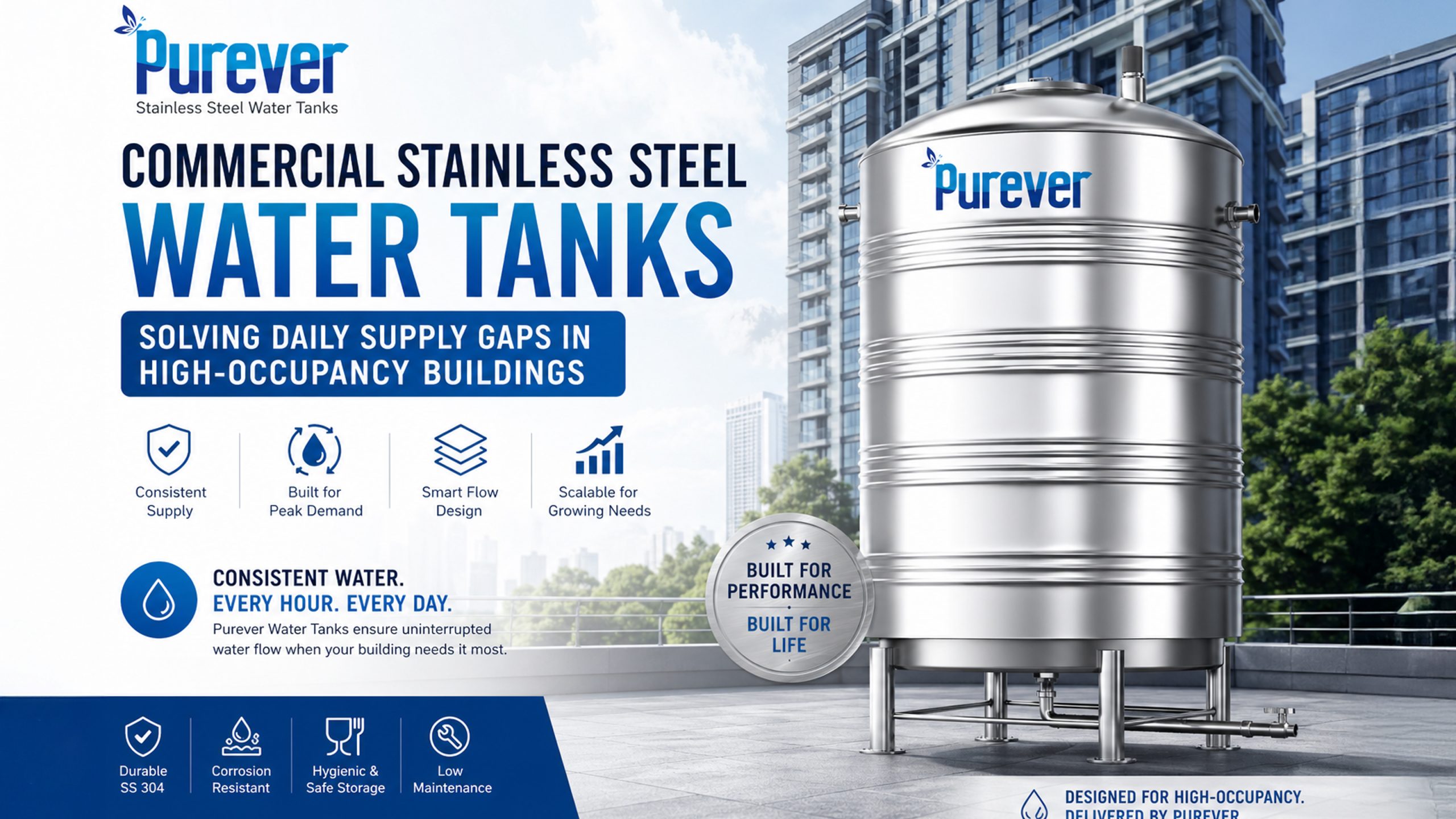
Purever designs Purever Water Tanks with real-world demand patterns in mind. Their Commercial stainless steel Water Tanks are built to handle peak usage, continuous cycles, and evolving building needs.
Instead of focusing only on capacity, Purever Water Tanks consider flow, distribution, and long-term reliability, helping buildings avoid daily supply gaps.
The Goal Isn’t Just Storage, It’s Consistency
In high-occupancy buildings, water systems aren’t judged by how much they store. They’re judged by how consistently they deliver.
With the right Commercial SS Water Tank setup, supported by efficient Commercial stainless steel Water Tanks and well-designed Purever Water Tanks, those daily supply gaps start disappearing.
And when that happens, complaints drop, operations smooth out, and the system finally feels… reliable.