
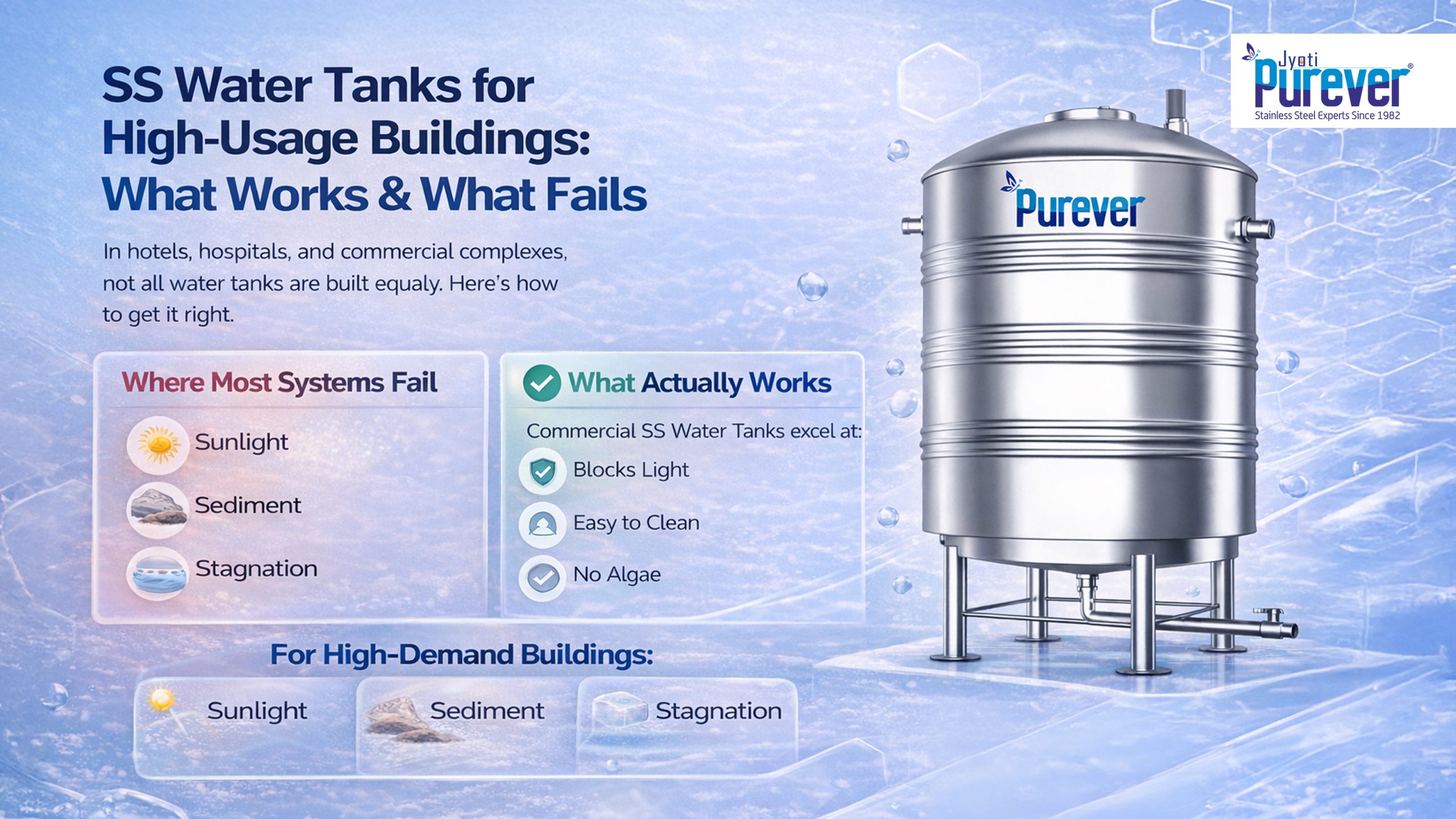
High-usage buildings don’t forgive mistakes. A hotel during peak season, a hospital running round-the-clock, a commercial complex with hundreds of users, these places don’t get “off hours.” Water storage systems either cope quietly, or they become a daily headache.
After seeing enough projects over the years, one thing becomes clear very quickly: not every tank that works for a home can survive in a high-usage environment. That’s where the right SS Water Tank makes all the difference.
Where Most Systems Start Failing
Failures rarely happen on day one. They show up after a year or two, when usage patterns settle in.
Plastic tanks soften under constant refilling and draining. Concrete tanks hold up structurally but develop hygiene issues that are hard to control. Lids warp. Algae builds. Cleaning schedules get more aggressive. And suddenly, maintenance teams are spending far too much time managing water storage.
In high-usage buildings, these “small” issues multiply fast. That’s why most facility managers eventually move toward Commercial SS Water Tanks, not because they’re premium, but because they’re predictable.
What Actually Works Under Constant Demand
A well-designed SS Water Tank handles pressure cycles better than most materials. Steel doesn’t flex with heat. It doesn’t crack under repeated load. And it doesn’t react with water, even when usage is heavy.
But here’s the important part: steel alone isn’t enough.
Design matters.
High-usage buildings need:
proper inlet and outlet placement
enough height to maintain pressure
smooth interiors for quick cleaning
access points that don’t disrupt operations
When these things are right, Commercial SS Water Tanks quietly do their job without becoming a daily concern.
Hygiene Isn’t Optional at This Scale
The more people use a system, the faster contamination risks appear. Light entering the tank, residue settling in corners, water stagnating during low-demand hours, all of this becomes a problem faster in large buildings.
A SS Water Tank blocks light completely and offers a non-porous interior surface. That alone reduces algae growth drastically. Cleaning becomes easier, quicker, and far less frequent.
In hospitals and food facilities, this isn’t a preference, it’s a requirement. That’s why Commercial SS Water Tanks are often specified upfront in high-usage projects rather than added later as a fix.
Where Things Still Go Wrong
Not all steel tanks perform equally.
Poor welding creates hidden weak points. Rough interiors trap residue. Bad sizing leads to pressure imbalance. These are the failures people blame on “steel tanks” when the real issue is execution.
A Purever Steel Water Tank avoids these problems by focusing on real-world usage rather than just capacity numbers. Tanks are designed for how water flows, how often they’re cleaned, and how the building actually operates day to day.
That practical thinking is what separates systems that survive from those that struggle.
The Long View Matters Most
High-usage buildings don’t benefit from short-term savings. Every replacement, shutdown, or emergency repair costs more than the tank itself.
A reliable SS Water Tank reduces:
emergency maintenance
hygiene-related downtime
replacement cycles
Over time, Commercial SS Water Tanks almost always cost less, not because they’re cheaper, but because they don’t fail when demand is highest.
Conclusion
Purever’s experience with Purever Steel Water Tank systems comes largely from high-usage environments – hotels, hospitals, and commercial facilities that can’t afford inconsistency. Their SS Water Tank designs focus on durability, hygiene, and ease of operation rather than flashy features.
That’s why many buildings using Commercial SS Water Tanks from Purever rarely talk about their water storage at all, and that’s usually a good sign.