
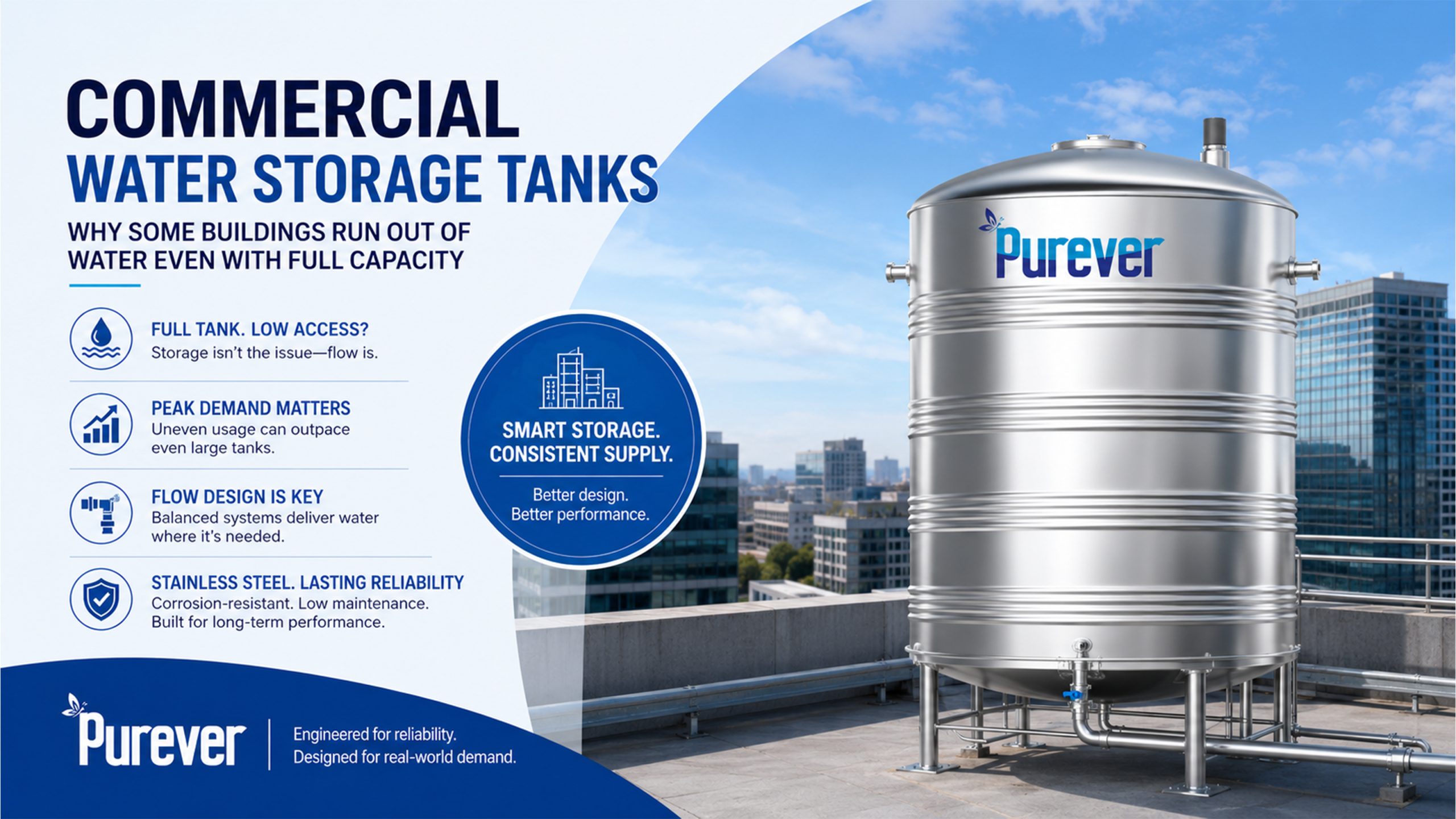
There’s a frustrating situation that happens in many commercial buildings. The tanks are technically full, the water supply is active, and yet people on certain floors still complain there’s “no water.”
At first, everyone blames the obvious things. Maybe the municipal supply is irregular. Maybe the pumps are weak. Maybe usage suddenly increased.
But after enough inspections, the same pattern usually appears: the issue isn’t the amount of stored water. It’s how the storage system has been planned.
And honestly, this is more common than most people realise with large commercial water storage tanks.
Full Capacity Doesn’t Always Mean Usable Capacity
A tank holding water and a building receiving water efficiently are two completely different things.
Many commercial properties install large commercial ss water tanks assuming bigger storage automatically guarantees smoother operations. But water systems don’t work that simply.
If distribution is uneven, flow design is poor, or refill timing doesn’t match actual demand, even full commercial stainless steel tanks can leave parts of the building struggling during peak hours.
That’s the hidden gap – storage exists, but accessibility becomes inconsistent.
Peak Demand Changes Everything
Commercial buildings rarely use water evenly throughout the day.
Hotels experience heavy morning usage.
Hospitals see unpredictable spikes.
Office buildings peak during breaks and lunch hours.
A storage system designed only around total capacity often struggles during these concentrated demand periods.
This is where poorly planned commercial water storage tanks start feeling unreliable. Water gets consumed faster in certain zones, pressure drops unevenly, and the system reacts slower than the building needs it to.
Why Oversized Tanks Sometimes Make the Problem Worse
One common response to shortage complaints is simple: install bigger tanks.
But larger commercial ss water tanks don’t automatically improve performance. In some cases, they create new inefficiencies:
Uneven refill cycles
Slower circulation
Increased overflow during low demand
Pressure imbalance across floors
The issue usually isn’t “not enough water.” It’s that the water isn’t moving efficiently through the system.
That’s why modern commercial Stainless steel tanks are increasingly designed as part of a larger distribution strategy instead of isolated storage units.
Flow Design Is the Real Game Changer
Experienced facility teams eventually notice something important, water problems are often flow problems disguised as storage problems.
Things like:
Poorly positioned outlets
Unbalanced pipelines
Insufficient zoning
Delayed refill coordination
…all affect how usable the stored water actually becomes.
Well-designed commercial water storage tanks consider these operational details from the beginning. The focus shifts from simply holding water to making sure the water reaches where it’s needed at the right time.
Why Stainless Steel Helps Systems Stay Predictable
Material consistency matters more in commercial environments because the demand itself is already unpredictable.
With commercial Stainless steel tanks, you get:
Better structural reliability
Smoother internal surfaces
Reduced risk of corrosion or contamination buildup
This stability helps maintain predictable performance over years of continuous use. Properly designed commercial ss water tanks remove one major variable from the system, material degradation.
And in large facilities, fewer variables usually mean fewer operational surprises.
The Difference between Capacity and Performance
This is something many building managers only realize after upgrading the system properly.
Good water storage doesn’t feel dramatic. It feels stable.
Pressure remains consistent.
Peak hours stop becoming stressful.
Complaints reduce quietly over time.
That’s when it becomes obvious that the real issue was never just capacity—it was system behaviour.
Well-planned commercial water storage tanks are designed to support operations, not simply sit full on a terrace.
Where Purever Fits In
Purever focuses on designing storage systems that work under real commercial usage conditions. Their commercial Stainless steel tanks are planned around demand fluctuations, flow balance, and long-term operational stability.
By combining durable commercial ss water tanks with practical system planning, they help ensure that stored water remains consistently usable across the building—not just technically available.
Water Problems Usually Start Long Before the Tank Runs Empty
Most commercial buildings don’t suddenly “run out” of water because storage is insufficient.
They struggle because the system wasn’t designed to handle how the building actually consumes water.
With thoughtfully engineered commercial water storage tanks, supported by efficient commercial Stainless steel tanks and properly balanced commercial ss water tanks, the system stops reacting unpredictably and starts supporting daily operations the way it should.
Quietly, Reliably, Without constant intervention.