
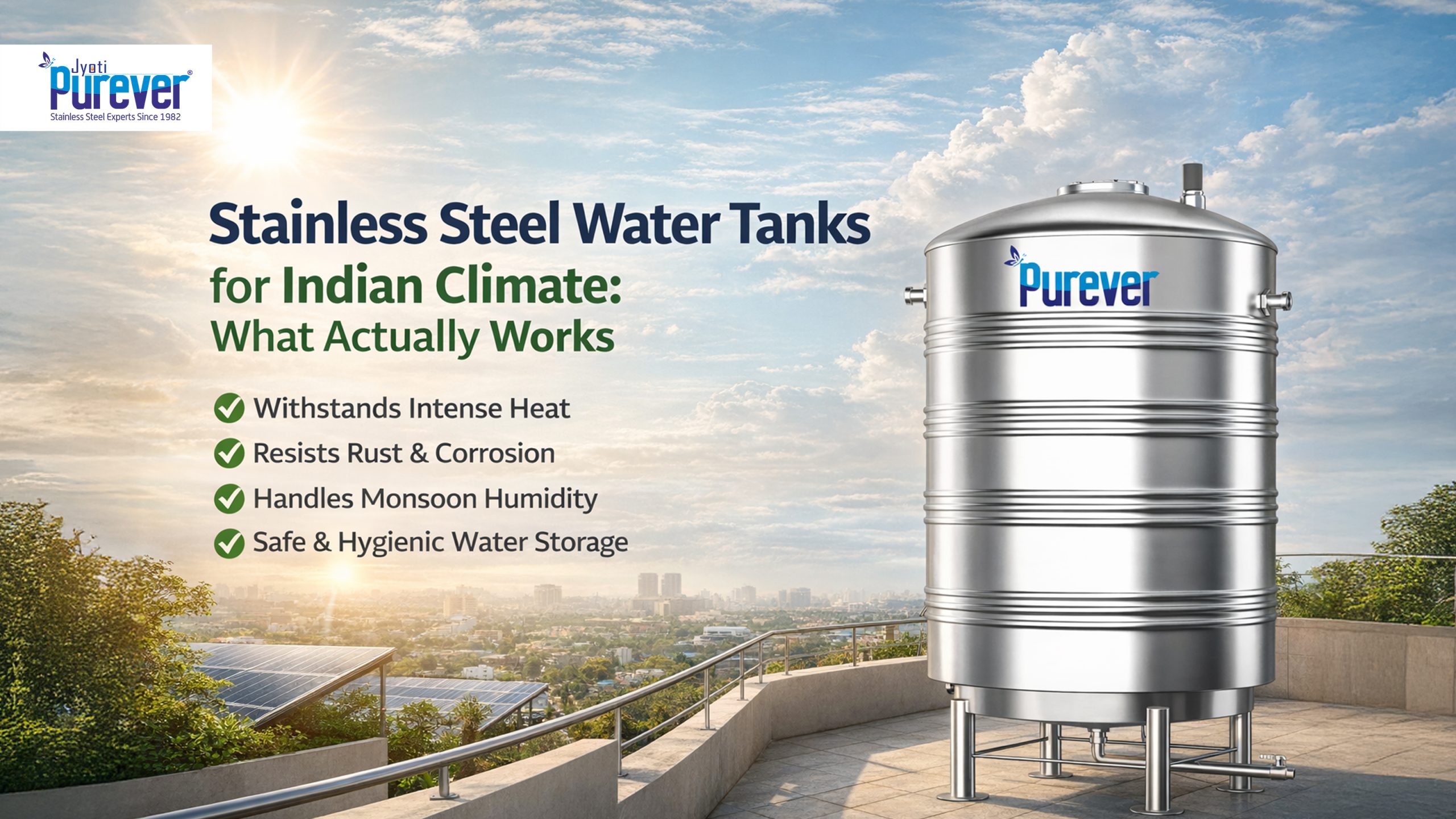
If you live in India, you already know our weather doesn’t believe in moderation. Summers that feel endless. Monsoons that test every joint and surface. Winters that aren’t harsh everywhere – but where they are, they matter.
So when people ask, “Which tank works best?” the real question is:
Which tank survives ten Indian summers and still behaves normally?
After seeing enough rooftops and basements over the years, a few things become clear about Stainless Steel Water Tanks in Indian conditions.
Heat Is the First Real Test
On many terraces, temperatures easily cross 55 – 60°C in peak summer. Plastic tanks soften. Lids warp. Fittings loosen. Even concrete expands and contracts unevenly.
A properly built Stainless Steel Water Tanks system doesn’t behave like that. Steel holds its structure under heat. It doesn’t flex or deform, and it doesn’t release odour when temperatures rise.
That’s the first thing that actually works in India, structural stability.
In fact, many people only realise the value of a SS Water Storage Tank after their old tank shows signs of heat fatigue.
Monsoon Reveals Weak Points
Monsoon season doesn’t politely knock, it exposes flaws.
Poor welds start leaking. Rust shows up where the finish wasn’t handled properly. Water seeps into joints.
A high-quality SS Water Storage Tank resists this because stainless steel isn’t prone to rust in the same way ordinary steel is. But, and this matters, the quality of welding and finish determines whether the tank stays leak-proof.
That’s where choosing the right build becomes critical.
Hard Water & Mineral Content
Many regions in India deal with hard water. Over time, mineral deposits can react with inferior materials, weakening them slowly.
Good Stainless Steel Water Tanks don’t react chemically with stored water. They don’t alter taste. They don’t degrade because of mineral contact. This makes them far more dependable across regions, from coastal humidity to dry northern plains.
When people upgrade to a Customized SS Water Tank, they often notice that water taste and clarity remain consistent through seasonal shifts.
Space & Sunlight Matter More Than You Think
Indian terraces are rarely empty. Solar panels, AC units, piping – everything competes for space. Standard tanks often sit exposed to direct sunlight all day.
A Customized SS Water Tank helps here too. It can be designed to fit into shaded corners or align with the terrace layout better. Height and orientation can be adjusted to reduce direct heat exposure.
That’s something standard tanks don’t offer.
Over time, properly positioned Stainless Steel Water Tanks stay cooler, cleaner, and easier to maintain.
Cleaning Shouldn’t Feel Like a Seasonal Ritual
If a tank demands deep cleaning every few months, something isn’t right.
In Indian conditions, dust, humidity, and temperature changes can accelerate algae growth, especially in plastic tanks that allow light penetration.
A sealed SS Water Storage Tank blocks light completely. The smooth interior prevents residue from clinging. Cleaning becomes predictable instead of exhausting.
This is one reason why many commercial buildings now insist on Stainless Steel Water Tanks rather than experimenting with cheaper materials.
What Actually Works?
After years of watching tanks age in Indian climates, the formula is surprisingly simple:
Use high-grade stainless steel
Ensure strong, clean welds
Choose a Customized SS Water Tank when space is awkward
Avoid materials that react with heat or humidity
When done right, Stainless Steel Water Tanks stop being seasonal liabilities. They become stable infrastructure.
Conclusion
Purever designs Stainless Steel Water Tanks specifically with Indian climate in mind. Their Customized SS Water Tank solutions address real terrace constraints and long-term weather exposure. And their SS Water Storage Tank builds are engineered to handle heat, humidity, and heavy usage without constant attention.
In a country where weather tests everything, what actually works is simple:
A tank that doesn’t flinch.